









What Is Generative AI and How Does It Work?
 Mar 02,2026
  By Rahul Pandit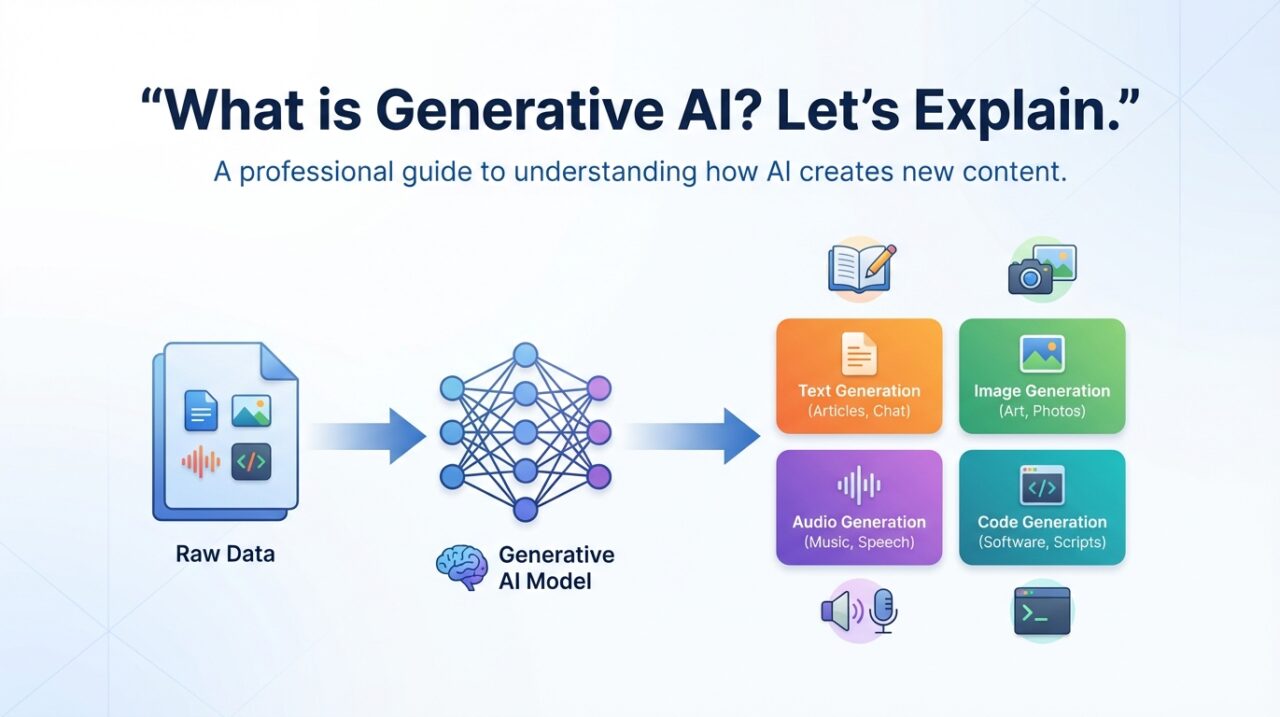
Generative AI is transforming how modern businesses build products, automate operations, and scale faster than ever before. From AI-powered chatbots and content engines to intelligent SaaS platforms and enterprise automation systems, generative AI is no longer experimental — it’s a competitive advantage.
In this blog, you’ll learn what Generative AI is, how large language models (LLMs) work, real-world business use cases, technology stacks required to build AI applications, and a step-by-step roadmap to implementing AI in your organization.
The AI Shift That’s Reshaping Business
Imagine launching a product that writes its own content, generates marketing visuals in seconds, answers customer queries 24/7, and analyzes complex data instantly.
This is not futuristic thinking. It’s happening now — powered by Generative AI.
From startups building AI-first SaaS platforms to enterprises automating internal operations, generative AI is becoming a competitive advantage rather than an experiment. Founders and CTOs are no longer asking “Should we use AI?” — they are asking “How fast can we implement it?”
If you’re exploring AI for your business, understanding how generative AI works is the first strategic step.
Why Generative AI Matters Now
Generative AI has moved from research labs into real-world production systems. The rapid adoption of large language models (LLMs), diffusion models, and transformer-based architectures has changed how software is built.
Businesses are using generative AI to:
- Reduce operational costs
- Increase product development speed
- Improve personalization
- Automate repetitive tasks
- Launch AI-native SaaS platforms
The companies integrating AI today are positioning themselves ahead of traditional competitors who rely solely on manual processes.
What Is Generative AI?
Generative AI is a type of artificial intelligence that can create new content — including text, images, audio, video, and even code — based on patterns learned from large datasets.
Unlike traditional AI systems that classify or predict outcomes, generative AI produces original outputs.
Examples of What Generative AI Can Create:
- Blog articles
- Chat responses
- Marketing copy
- UI designs
- Product descriptions
- Software code
- Synthetic data
- Images and videos
At its core, generative AI learns patterns from existing data and uses probability to generate meaningful new content.
How Does Generative AI Work?
To understand how generative AI works, we need to break it down into simple components.
1. Data Training
Generative models are trained on massive datasets containing text, images, code, or structured business data. During training, the model learns:
- Language structure
- Context relationships
- Statistical probabilities
- Patterns in data
The larger and more diverse the dataset, the better the model performs.
2. Neural Networks & Transformers
Modern generative AI systems use deep learning architectures such as:
- Transformer models
- Diffusion models
- Generative Adversarial Networks (GANs)
Transformer-based models are especially powerful for text generation because they understand context across long sequences, enabling more accurate and human-like outputs.
3. Large Language Models (LLMs)
Large Language Models (LLMs) are trained on billions of parameters and can:
- Predict the next word in a sentence
- Maintain conversation context
- Generate human-like responses
- Summarize, translate, and rewrite content
They do not “think” like humans — they calculate probabilities based on patterns learned during training.
4. Prompt-Based Output Generation
When a user enters a prompt, the model:
- Processes the input
- Analyzes context
- Predicts probable outputs
- Generates structured content
This is why prompt engineering plays a critical role in production-grade AI systems.
Benefits of Generative AI for Businesses
For founders, CTOs, and product leaders, the real question is: how does this translate into ROI?
1. Faster Product Development
AI-assisted development can generate:
- Code snippets
- Documentation
- UI layouts
- Test cases
This accelerates MVP launches and reduces development time significantly.
2. Operational Efficiency
Generative AI automates:
- Customer support
- Email responses
- Report generation
- Internal documentation
This reduces manual workload and operational costs.
3. Personalization at Scale
AI can dynamically generate:
- Personalized emails
- Custom landing pages
- AI-powered chat experiences
- Targeted product recommendations
This level of personalization was previously resource-intensive and difficult to scale.
4. Scalable SaaS Opportunities
Startups are building AI-native SaaS products that offer:
- AI writing tools
- AI analytics dashboards
- AI-powered CRM automation
- Industry-specific AI copilots
If you’re planning to build something similar, our team can help design and deploy scalable AI-powered solutions tailored to your business model.
Real-World Use Cases of Generative AI
1. AI Chatbots & Virtual Assistants
Businesses deploy AI-powered chat systems integrated with knowledge bases using Retrieval-Augmented Generation (RAG) to provide accurate and contextual answers.
2. AI Content Platforms
Automated blog writing, SEO generation, and marketing content creation platforms are rapidly growing in demand.
3. AI Code Assistants
Developers use AI to generate and review code faster, improving productivity and reducing development cycles.
4. AI in Healthcare & FinTech
- Synthetic data generation
- Risk modeling
- Automated compliance documentation
- Intelligent reporting
5. AI for Enterprise Automation
Internal AI copilots are transforming:
- HR processes
- Sales workflows
- Customer support systems
- Operations management
Technology Stack for Building Generative AI Applications
A production-ready generative AI solution typically includes:
Frontend
- Flutter (cross-platform mobile apps)
- React.js (web dashboards and admin panels)
Backend
- Python
- FastAPI
- Node.js
AI Layer
- Open-source LLMs
- API-based LLM integrations
- RAG architecture
- Vector databases
Cloud & Infrastructure
- AWS
- Azure
- Google Cloud
- GPU-enabled servers
DevOps & Scaling
- Docker
- Kubernetes
- CI/CD pipelines
We offer end-to-end development — from AI model integration to frontend, backend, cloud deployment, and long-term scalability planning.
Step-by-Step Approach to Developing a Generative AI Product
Step 1: Problem Identification
Define clear business objectives and measurable KPIs.
Step 2: Data Strategy
Determine:
- What data is required?
- Is fine-tuning needed?
- Is RAG sufficient?
Step 3: Model Selection
Choose between:
- Pre-trained APIs
- Open-source LLM deployment
- Custom fine-tuned models
Step 4: Architecture Design
Plan:
- Backend APIs
- AI inference layer
- Data pipelines
- Security and compliance
Step 5: UI/UX Integration
Build intuitive AI interfaces in Flutter or React.
Step 6: Testing & Optimization
Focus on:
- Output quality
- Prompt optimization
- Latency
- Cost efficiency
Step 7: Deployment & Scaling
Use cloud-native infrastructure with monitoring and performance analytics.
If you’d like a tailored roadmap for your AI initiative, you can Schedule a Free Consultation to evaluate feasibility and implementation strategy.
Common Mistakes to Avoid
- Implementing AI without a clear use case
- Ignoring data privacy and compliance
- Underestimating infrastructure costs
- Skipping prompt engineering
- Not planning for scalability
AI is powerful — but only when aligned with business strategy.
Future Trends in Generative AI
The next wave of AI innovation will include:
- AI agents performing multi-step tasks
- Autonomous SaaS systems
- Hyper-personalized enterprise workflows
- AI + IoT integrations
- Low-code AI builders
- Edge AI deployments
Businesses that integrate AI early will build defensible competitive advantages.
Conclusion: Is Generative AI Right for Your Business?
Generative AI is not just a trend — it is a foundational technology reshaping software development, product engineering, and digital transformation.
For startup founders, CTOs, and enterprises, the opportunity lies in:
- Building AI-first products
- Embedding AI into existing platforms
- Automating workflows
- Scaling operations intelligently
The key is strategic implementation — not experimentation without direction.
If you are evaluating how generative AI can enhance your product or operations, our experts can help you define the right architecture, technology stack, and roadmap.
Frequently Asked Questions (FAQs)
1. What is Generative AI in simple terms?
Generative AI is a type of artificial intelligence that creates new content such as text, images, code, and audio by learning patterns from large datasets.
2. How does Generative AI work?
Generative AI works using deep learning models like transformers and large language models that predict and generate outputs based on probabilities learned during training.
3. Is Generative AI suitable for startups?
Yes. Startups can use generative AI to automate operations, build AI-powered SaaS products, enhance customer support, and reduce development costs.
4. What is the difference between traditional AI and Generative AI?
Traditional AI focuses on classification and prediction, while generative AI creates original content such as articles, designs, and conversational responses.
5. How much does it cost to build a Generative AI application?
Costs depend on infrastructure, model selection, development complexity, and scaling requirements. API-based integrations are more affordable initially, while custom AI systems require higher investment but offer greater control and flexibility.


 Apr 02, 2026

