









Introduction to Agentic AI Systems
 Mar 30,2026
  By Rahul Pandit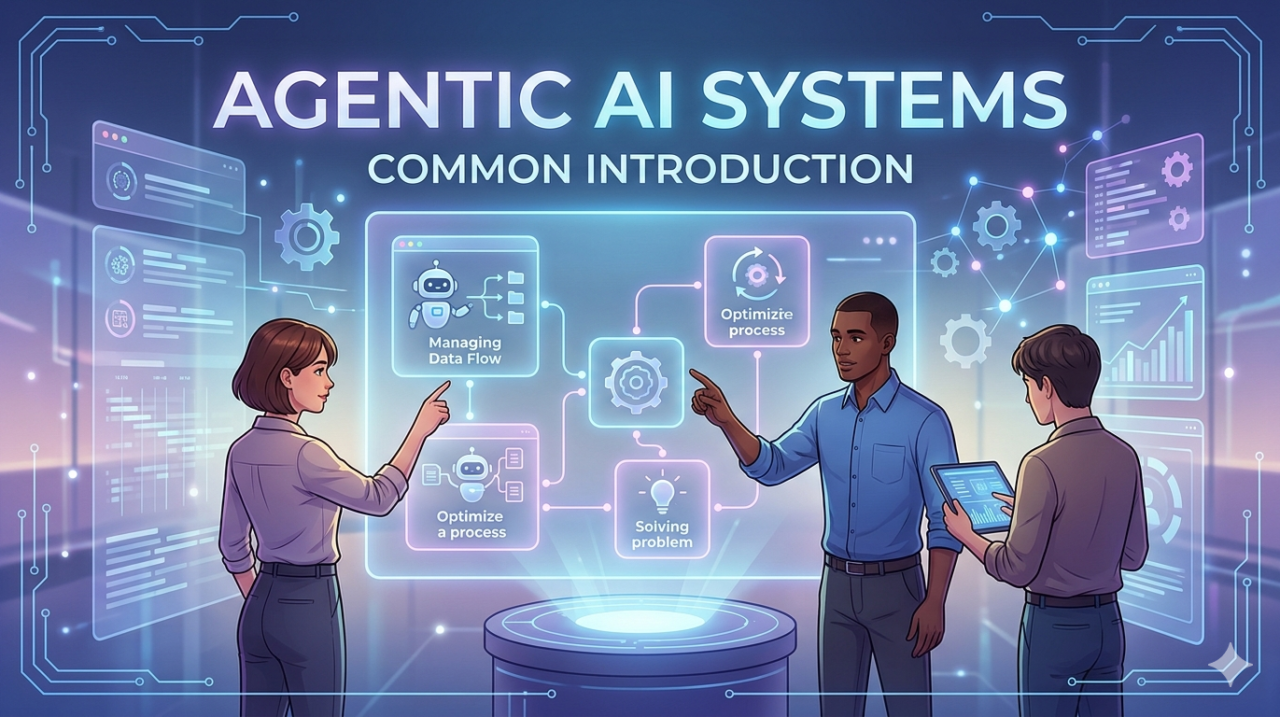
Artificial Intelligence has rapidly evolved—from rule-based systems to advanced generative models. But today, we are entering a new phase: Agentic AI systems.
Unlike traditional AI tools that wait for instructions, agentic AI systems can plan, decide, and act autonomously to achieve goals.
For startups and enterprises, this shift represents a massive opportunity—automating workflows, enhancing productivity, and building intelligent systems that operate with minimal human intervention.
The question is no longer “Can AI assist us?” but “Can AI act on our behalf?”
Industry Insight: Why Agentic AI is Gaining Momentum
- The global AI market is projected to exceed $1 trillion by 2030
- Businesses adopting AI automation report up to 40% productivity gains
- Autonomous AI agents are becoming core to SaaS, fintech, healthcare, and eCommerce platforms
With advancements in large language models (LLMs), agentic systems are becoming more reliable, context-aware, and capable of handling complex workflows.
What Are Agentic AI Systems?
Agentic AI systems are autonomous software entities that can:
- Understand goals
- Break tasks into steps
- Make decisions
- Execute actions
- Learn from outcomes
They combine:
- Large Language Models (LLMs)
- Memory systems
- Planning modules
- Tool integrations
Key Characteristics:
- Goal-driven behavior
- Continuous learning and adaptation
- Multi-step task execution
- Integration with external tools (APIs, databases)
How Agentic AI Systems Work
Agentic AI systems typically follow a loop:
- Input Understanding
- Planning
- Execution
- Feedback & Iteration
Core Components:
1. LLM (Brain)
Processes language, reasoning, and decision-making.
2. Memory Layer
Stores context, past interactions, and learned data.
3. Planner Module
Breaks down complex tasks into smaller steps.
4. Tool Integration Layer
Interacts with APIs, databases, or external systems.
5. Execution Engine
Performs tasks and updates results.
Benefits of Agentic AI for Businesses
Increased Productivity
Automate repetitive and complex workflows.
Smarter Decision-Making
AI agents analyze data and recommend actions.
Faster Operations
Tasks that took hours can now be done in seconds.
Cost Efficiency
Reduce manual labor and operational overhead.
Scalability
Easily scale operations without increasing workforce.
For companies aiming to stay competitive, agentic AI is not just an advantage—it’s becoming a necessity.
Real-World Use Cases
1. Customer Support Automation
AI agents handle queries, escalate issues, and resolve tickets.
2. Sales & Lead Qualification
Agents analyze leads, send follow-ups, and schedule meetings.
3. DevOps Automation
AI monitors systems, detects issues, and triggers fixes.
4. Content Generation Pipelines
Automate blogs, social media, and marketing campaigns.
5. Financial Operations
Invoice processing, fraud detection, and reporting.
If you’re planning to build AI-driven automation systems like these, our team can help you design scalable and production-ready solutions — you can “Schedule a Free Consultation” to explore possibilities.
Recommended Technology Stack for Agentic AI
AI & LLMs:
- OpenAI GPT models
- Open-source LLMs (LLaMA, Mistral)
Frameworks:
- LangChain
- AutoGen
- CrewAI
Backend:
- FastAPI
- Node.js
Frontend:
- React
- Flutter
Databases:
- PostgreSQL
- Vector databases (Pinecone, Weaviate)
Cloud:
- AWS
- Google Cloud
DevOps:
- Docker
- Kubernetes
Choosing the right stack is critical to ensure performance, scalability, and reliability of agentic systems.
Step-by-Step Approach to Building Agentic AI Systems
Step 1: Define Clear Objectives
- What tasks should the AI agent perform?
- What outcomes are expected?
Step 2: Select the Right LLM
- Based on complexity, cost, and latency
Step 3: Design the Agent Workflow
- Define planning logic
- Create task sequences
Step 4: Integrate Tools & APIs
- CRM systems
- Payment gateways
- Internal databases
Step 5: Implement Memory
- Short-term context
- Long-term knowledge
Step 6: Build Feedback Loops
- Monitor outputs
- Improve accuracy over time
Step 7: Deploy & Monitor
- Use cloud infrastructure
- Track performance metrics
If you’re unsure how to design or deploy agentic AI systems, we offer end-to-end development support — from strategy to deployment. You can “Talk to Our Experts” for guidance tailored to your business.
Common Mistakes to Avoid
Overestimating AI Autonomy
AI still needs guardrails and human oversight.
Ignoring Data Quality
Poor data leads to poor decisions.
Lack of Monitoring
Unmonitored agents can produce unexpected results.
No Security Measures
Ensure data privacy and secure integrations.
Poor Prompt Engineering
Bad prompts lead to unreliable outputs.
Avoiding these mistakes ensures your AI systems remain efficient, safe, and scalable.
Future Trends in Agentic AI
1. Multi-Agent Systems
Multiple AI agents collaborating to solve complex problems.
2. AI + SaaS Integration
Agentic AI becoming a core feature in SaaS products.
3. Autonomous Enterprises
Businesses running partially or fully on AI agents.
4. AI Governance & Regulation
Stronger focus on ethical AI and compliance.
5. Human-AI Collaboration
AI agents augmenting human decision-making.
Conclusion
Agentic AI systems are redefining how businesses operate.
They move beyond automation into intelligent autonomy, enabling organizations to scale faster, operate smarter, and innovate continuously.
For startups and enterprises, adopting agentic AI early can unlock massive competitive advantages.
If you’re looking to integrate AI agents into your product or workflow, we provide complete development solutions — from ideation to deployment. You can also “Get a Project Estimation” to plan your next move.
FAQ Section
1. What are agentic AI systems?
Agentic AI systems are autonomous AI systems that can plan, execute, and optimize tasks to achieve specific goals.
2. How do agentic AI systems work?
They use LLMs, memory, planning modules, and tool integrations to perform tasks in a continuous feedback loop.
3. What are the benefits of agentic AI?
They improve efficiency, automate workflows, reduce costs, and enable smarter decision-making.
4. Which industries use agentic AI?
Industries like SaaS, fintech, healthcare, eCommerce, and logistics use agentic AI systems.
5. Is agentic AI suitable for startups?
Yes, startups can leverage agentic AI to scale operations, automate tasks, and gain a competitive edge.


 Apr 02, 2026

