









How Transformer Architecture Powers Modern AI
 Mar 23,2026
  By Rahul Pandit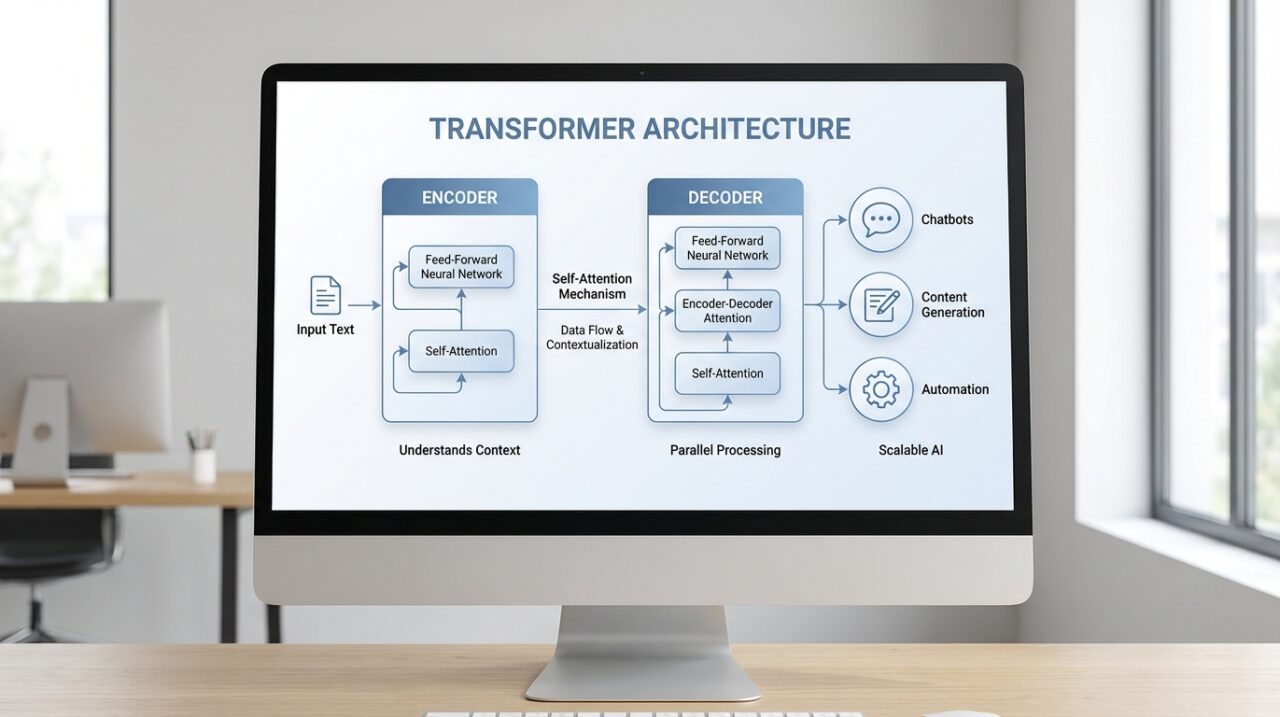
In today’s fast-evolving digital landscape, artificial intelligence is no longer a luxury—it’s a necessity for businesses aiming to stay competitive. From intelligent chatbots to advanced analytics, modern AI applications are transforming how companies operate and deliver value. At the core of this revolution lies transformer architecture, a breakthrough that enables machines to understand context, generate human-like responses, and scale efficiently. For startups and enterprises alike, leveraging this technology can unlock new opportunities for innovation, automation, and growth.
Introduction: Why Traditional AI Wasn’t Enough
A few years ago, AI systems struggled with context.
Chatbots gave robotic replies. Translation tools missed nuance. Recommendation engines felt inaccurate.
For businesses, this meant:
- Poor customer experiences
- Limited automation capabilities
- High dependency on manual processes
Then came a breakthrough: Transformer Architecture.
Today, it powers everything from chatbots to AI copilots, content generators, and enterprise automation systems.
If you’re a founder, CTO, or product leader, understanding transformers is no longer optional—it’s a strategic advantage.
Industry Insight: The Rise of Transformer-Based AI
Modern AI systems like Large Language Models (LLMs) are built on transformer architecture.
Key trends:
- Majority of NLP advancements are transformer-based
- AI SaaS adoption is rapidly increasing
- Generative AI is becoming a core product feature
This shift is redefining how businesses build and scale products.
What is Transformer Architecture?
Transformer architecture is a deep learning model that uses an attention mechanism to process data efficiently.
Instead of reading data sequentially, it analyzes the entire input at once, enabling better context understanding.
Key Components
1. Self-Attention
Allows the model to determine which words or elements are most important.
2. Positional Encoding
Adds sequence information so the model understands order.
3. Encoder-Decoder Structure
- Encoder: Processes input
- Decoder: Generates output
4. Multi-Head Attention
Handles multiple relationships simultaneously for better accuracy.
Why Transformers Matter for Businesses
Transformer architecture is not just technical—it directly impacts business growth.
Key Benefits
Better Customer Experience
- Human-like chatbot responses
- Context-aware communication
Automation at Scale
- Reduce manual work
- Improve operational efficiency
Faster Product Development
- Rapid AI feature integration
- Faster MVP launches
Data-Driven Insights
- Analyze large volumes of unstructured data
👉 If you’re planning to integrate AI into your product, our team can help you design and build scalable solutions. Talk to Our Experts.
Real-World Use Cases
AI Chatbots
Automated customer support and lead generation.
Content Generation
Blogs, marketing content, and automation tools.
Code Generation
AI-powered developer tools.
Recommendation Systems
Personalized product or content suggestions.
Document Processing
Summarization and data extraction from documents.
Technology Stack Example
Frontend
- React.js
- Flutter
Backend
- FastAPI
- Node.js
AI Layer
- Transformer models
- OpenAI / Hugging Face
Infrastructure
- AWS / GCP
- Docker / Kubernetes
Database
- PostgreSQL
- Vector databases
👉 We offer end-to-end development from idea to deployment. You can Get a Project Estimation based on your requirements.
Step-by-Step Development Approach
Step 1: Define Use Case
Identify problem and target users.
Step 2: Data Preparation
Collect and clean data.
Step 3: Model Selection
Choose pre-trained or custom transformer models.
Step 4: Backend Integration
Develop APIs and logic.
Step 5: Frontend Development
Build user interface.
Step 6: Testing
Optimize performance and cost.
Step 7: Deployment
Launch and scale system.
👉 Need help building your AI product? Schedule a Free Consultation today.
Common Mistakes to Avoid
- Overbuilding in early stages
- Ignoring data quality
- Not optimizing costs
- Poor user experience design
- Lack of scalability planning
Future Trends
Multimodal AI
Combining text, images, and audio.
Efficient Models
Smaller and faster transformers.
AI Agents
Autonomous systems performing tasks.
Industry-Specific AI
Vertical SaaS AI products.
Conclusion
Transformer architecture is the backbone of modern AI systems.
It enables smarter applications, faster innovation, and scalable automation.
Businesses that adopt this technology early will gain a strong competitive advantage.
FAQ Section
1. What is transformer architecture?
Transformer architecture is a deep learning model that uses attention mechanisms to understand relationships in data efficiently.
2. Why is transformer architecture important?
It improves accuracy, scalability, and context understanding in AI systems.
3. Where are transformers used?
They are used in chatbots, content generation, recommendation systems, and analytics tools.
4. Can startups use transformer-based AI?
Yes, startups can integrate transformer models using APIs or custom solutions based on their needs.
5. How much does it cost to build AI systems using transformers?
Costs vary depending on complexity, infrastructure, and usage, but starting with APIs is cost-effective.


 Apr 02, 2026

