










How We Built a Finance Management System (Without Sharing Client Data)
 Feb 21,2026
  By Rahul Pandit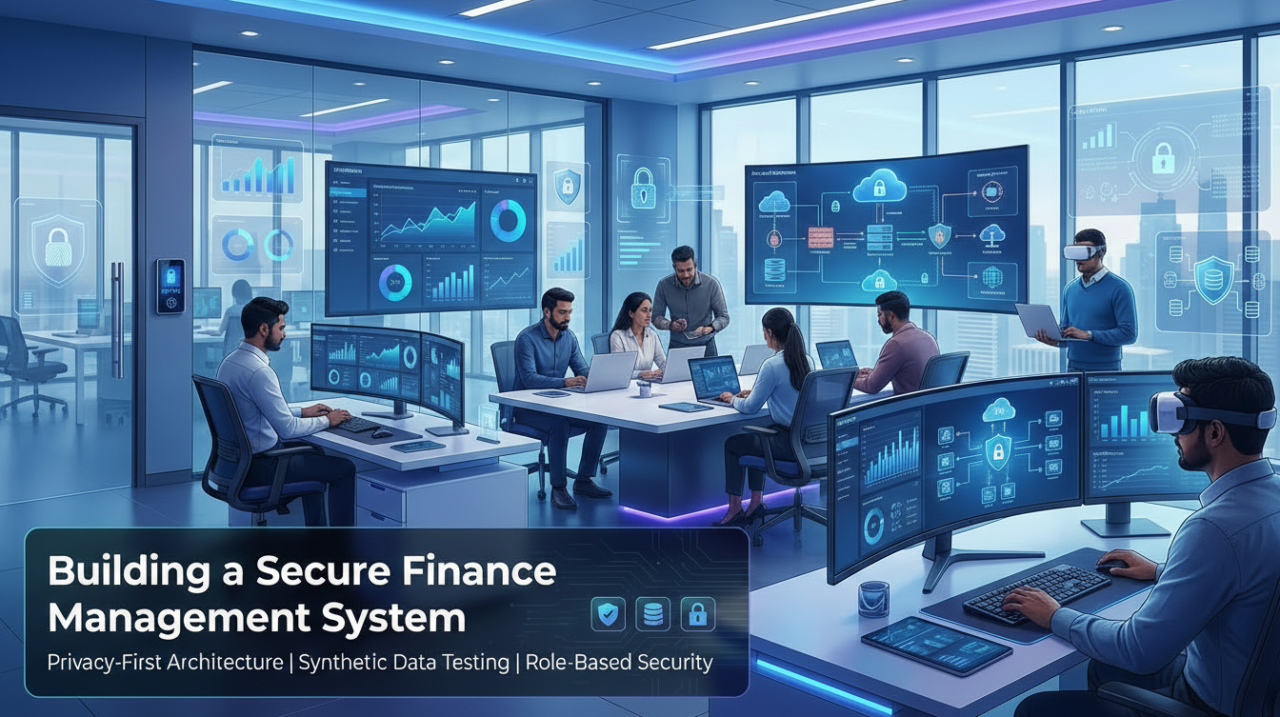
Building secure financial software requires more than features — it demands architecture that protects sensitive data from day one. In this blog, we break down how we engineered a finance management system without ever accessing real client information.
From privacy-first infrastructure to synthetic data testing and role-based controls, this article outlines our development strategy, technology stack, and key lessons for startups and enterprises building secure fintech or SaaS platforms.
The Real Challenge Behind Finance Software
Every startup founder, CTO, and enterprise decision-maker eventually faces a serious challenge: building a powerful finance management system without compromising sensitive client data.
Financial systems handle extremely sensitive information such as:
- Transaction histories
- Bank account references
- KYC documentation
- Payment workflows
- Investment and return structures
- Internal accounting records
One misconfigured API. One unsecured storage bucket. One overlooked permission rule.
And years of brand trust can disappear overnight.
When we were approached to build a finance management system, the primary condition was clear:
The system must be built without exposing or sharing real client data during development.
This requirement shaped every architectural decision we made.
Why Data Security Is the Foundation of Finance Software
Finance and fintech platforms remain among the most targeted industries for cyber threats. As SaaS platforms scale, so does the attack surface:
- API integrations
- Cloud infrastructure
- Multi-tenant environments
- Mobile applications
- Third-party services
Security is not an add-on feature in financial software. It is the backbone.
A modern finance management system must ensure:
- Encryption at rest and in transit
- Role-based access control (RBAC)
- Environment isolation
- Detailed audit logs
- Secure API architecture
Without this foundation, scaling becomes risky and unsustainable.
Project Objective
The system required the following core capabilities:
- Group-based finance management
- Admin-controlled approvals
- Manual KYC workflows
- UPI-based payment integration
- Multi-user group support (up to 300 users per group)
- Master admin panel
- Static return plan configuration
But with one strict rule:
No live financial data, PAN, Aadhaar, or real banking records could be shared with the development team.
Privacy-First Architecture Strategy
1. Isolated Development Environment
We created a fully sandboxed development and staging infrastructure. Instead of using real client data, we worked with:
- Synthetic financial datasets
- Mock KYC documents
- Simulated UPI payment responses
- Programmatically generated user profiles
This allowed complete end-to-end testing without accessing any real financial records.
Environment separation was strictly maintained:
- Development
- Staging
- Production
Each environment had isolated credentials, storage, and access controls.
2. Synthetic Data Generation
To accurately simulate real-world scenarios, we built structured synthetic datasets that mirrored actual user behavior.
These included:
- Multiple user tiers
- Approved and rejected KYC cases
- Failed and successful transactions
- Admin overrides
- Group contribution variations
This approach allowed realistic stress testing while protecting client confidentiality.
3. Role-Based Access Control (RBAC)
Finance systems cannot operate with flat permission structures.
We implemented multiple roles such as:
- Super Admin
- Group Admin
- Verified User
- Pending KYC User
- Read-Only Auditor
Each role had:
- Strict API-level authorization
- Backend validation enforcement
- UI-level visibility control
Even if someone manipulated frontend behavior, backend permission rules blocked unauthorized actions.
Security must always be enforced server-side.
Technology Stack Used
We selected a modern, scalable, and secure technology stack.
Backend
- Python with FastAPI
- JWT-based authentication
- Role-based middleware validation
- Structured logging and audit trails
- WebSocket for real-time updates
Frontend
- Flutter for cross-platform mobile applications
- React.js for the admin dashboard
Database
- PostgreSQL with row-level security policies
- Encrypted storage layers
Cloud Infrastructure
- Secure VPC configuration
- IAM-based role management
- Encrypted object storage
- Strict access monitoring
Choosing the right architecture early prevents expensive rework later.
If you’re planning to build something similar, designing security-first architecture before development begins is critical.
Step-by-Step Development Approach
Step 1: Module-Based Planning
We divided the system into clear modules:
- Authentication & onboarding
- KYC submission & review
- Payment integration
- Group management
- Finance return calculation logic
- Admin reporting & analytics
- Audit trail logging
Each module included defined security checkpoints.
Step 2: Data Flow Mapping
We mapped every data interaction:
- Where data enters the system
- How it is processed
- Where it is stored
- Who can access it
- Retention and deletion rules
This eliminated hidden vulnerabilities and improved traceability.
Step 3: API Hardening
Every API endpoint included:
- Schema validation
- Token authentication
- Role-based authorization
- Rate limiting
- Error monitoring
Finance APIs require strict validation to prevent misuse.
Step 4: Secure Payment Flow
Instead of storing raw banking credentials, we implemented:
- Secure redirection for UPI payments
- Server-side callback validation
- Transaction reference storage only
No sensitive banking details were stored inside the application database.
Step 5: Secure KYC Handling
KYC uploads were:
- Encrypted before storage
- Stored in isolated buckets
- Accessible only via time-limited secure URLs
- Logged for every access event
This ensures compliance readiness and audit support.
Business Benefits of a Privacy-First Finance System
A secure finance management system delivers measurable business advantages:
Regulatory Readiness
Prepared for audits and compliance reviews.
Increased Trust
Clients and investors gain confidence in your platform.
Scalable SaaS Model
Multi-tenant isolation prevents cross-user data exposure.
Reduced Legal Risk
Security architecture reduces breach exposure.
Higher Investor Confidence
Strong technical foundations increase enterprise valuation credibility.
We offer end-to-end product engineering from architecture design to secure deployment and scaling. You can Schedule a Free Consultation to explore your finance SaaS roadmap.
Common Mistakes to Avoid
Avoid these frequent errors in finance software development:
- Using real client data during testing
- Relying only on frontend permission checks
- Storing raw banking credentials
- Ignoring audit logging
- Mixing development and production environments
Fixing these issues later is significantly more expensive than building correctly from the start.
Future of Finance Management Systems
The next generation of financial platforms will integrate:
AI-Based Risk Detection
Machine learning models detecting abnormal transaction behavior.
Intelligent Financial Dashboards
Natural language-based analytics and reporting.
Automated Compliance Monitoring
Built-in regulatory rule validation engines.
Multi-Region SaaS Scalability
Tenant isolation across distributed cloud infrastructure.
Organizations that prioritize security, automation, and scalability today will dominate tomorrow’s financial technology landscape.
Conclusion
Building a finance management system without accessing real client data is not only possible — it is the smarter approach.
By leveraging:
- Synthetic datasets
- Isolated environments
- Role-based security
- Secure API architecture
- Encrypted cloud infrastructure
You reduce risk while building long-term scalability.
In finance, trust is the real product.
If you’re planning to develop a secure financial platform, our team specializes in privacy-first SaaS architecture, mobile applications, and scalable backend systems. You can Talk to Our Experts or Get a Project Estimation to start building securely from day one.


 Apr 02, 2026

