










Common Backend Architecture Mistakes in Startups
 Mar 30,2026
  By Rahul Pandit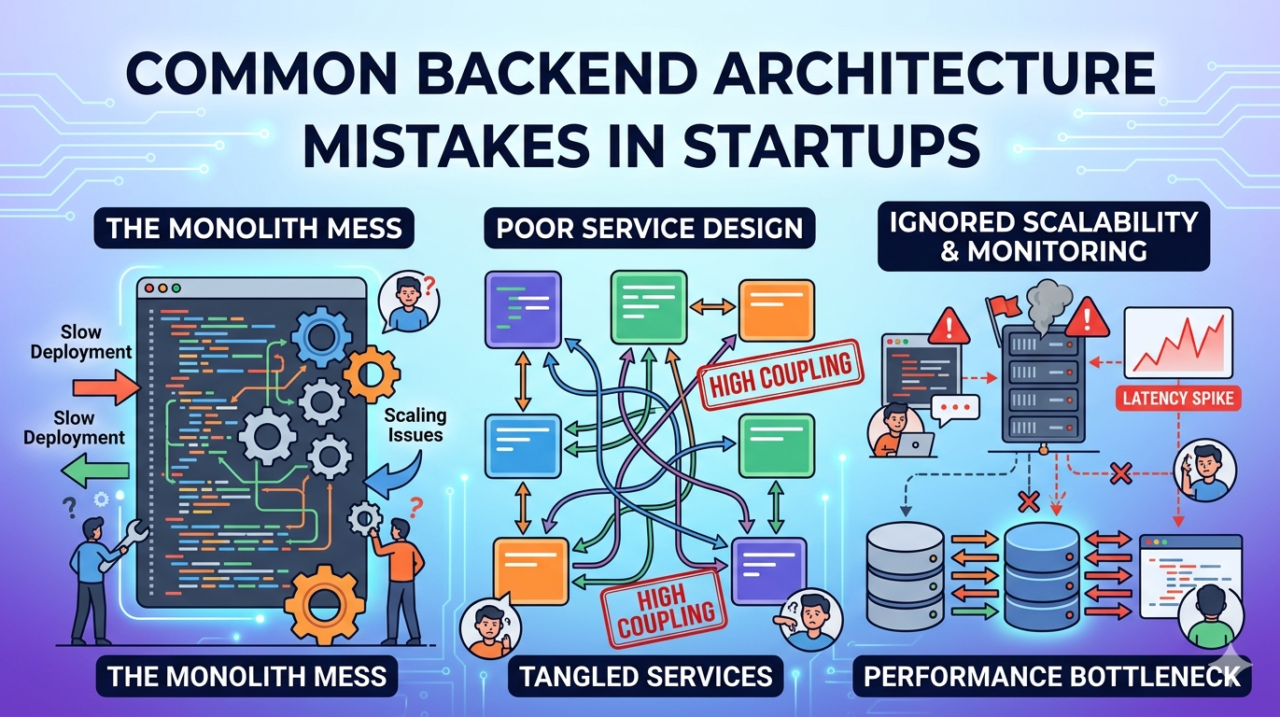
In the early stages of a startup, speed is everything. Founders prioritize launching quickly, validating ideas, and gaining traction. But in the rush to market, one critical aspect often gets overlooked — backend architecture.
A poorly designed backend may work initially, but as your product scales, it can become a bottleneck that slows performance, increases costs, and limits growth.
Many startups don’t fail because of bad ideas — they fail because their systems can’t scale.
This blog explores the most common backend architecture mistakes startups make, how to avoid them, and how to build a future-ready system from day one.
Industry Insight: The Cost of Poor Architecture
- Over 70% of startups face scalability issues within the first 2 years.
- Poor backend decisions can increase infrastructure costs by 30–50%.
- Rebuilding architecture later can cost 5x more than doing it right initially.
The takeaway? Backend architecture is not just a technical decision — it’s a business decision.
What is Backend Architecture?
Backend architecture refers to the structure and design of server-side systems that power your application, including:
- Databases
- APIs
- Servers
- Cloud infrastructure
- Authentication systems
- Business logic
It determines how your application performs, scales, and evolves.
Common Backend Architecture Mistakes in Startups
1. Overengineering Too Early
Many startups try to build complex systems with microservices from day one.
The Problem:
- Increased development time
- Higher operational complexity
- Difficult debugging
Better Approach:
Start with a modular monolith and evolve into microservices when needed.
2. Ignoring Scalability from Day One
Some startups assume they can “fix scaling later.”
The Problem:
- System crashes under load
- Poor user experience
- Expensive rework
Solution:
- Use scalable cloud platforms like AWS
- Design stateless services
- Implement load balancing early
3. Poor Database Design
A weak database schema can destroy performance.
Common Issues:
- No indexing
- Over-normalization
- Inefficient queries
Best Practices:
- Choose the right database (SQL vs NoSQL)
- Optimize queries
- Plan for data growth
4. Tight Coupling Between Components
When services depend heavily on each other, even small changes become risky.
Impact:
- Slower development cycles
- Frequent bugs
- Limited flexibility
Fix:
- Use APIs and service layers
- Follow loose coupling principles
5. Lack of Proper API Design
APIs are the backbone of modern applications.
Mistakes:
- Inconsistent endpoints
- No versioning
- Poor documentation
Solution:
- Follow REST or GraphQL standards
- Use versioning (v1, v2)
- Maintain clear documentation
6. Ignoring Security Early
Security is often treated as a “later problem.”
Risks:
- Data breaches
- Compliance issues
- Loss of user trust
Must-Haves:
- Authentication (JWT, OAuth)
- Encryption
- Secure APIs
7. No Monitoring or Logging
Without visibility, you can’t fix problems.
Consequences:
- Undetected failures
- Slow debugging
- Poor performance insights
Solution:
- Use tools like ELK Stack
- Implement real-time monitoring
- Track system metrics
8. Not Using Caching Properly
Failing to implement caching leads to unnecessary load on servers.
Fix:
- Use Redis or Memcached
- Cache frequently accessed data
- Reduce database hits
Benefits of a Well-Designed Backend Architecture
A strong backend architecture enables:
- Faster performance
- Easy scalability
- Reduced operational costs
- Enhanced security
- Faster feature development
For startups aiming to grow quickly, this becomes a competitive advantage.
Real-World Use Case
Scenario: SaaS Startup Scaling Issues
A SaaS startup initially built a monolithic backend without scalability considerations.
Challenges:
- Slow API response times
- Frequent downtime
- Increasing cloud costs
Solution Implemented:
- Migrated to microservices gradually
- Introduced caching with Redis
- Optimized database queries
Result:
- 60% performance improvement
- 40% cost reduction
- Better user experience
Recommended Technology Stack for Startups
Choosing the right stack is critical:
Backend Frameworks:
- Node.js (Express, NestJS)
- Python (FastAPI, Django)
- Java (Spring Boot)
Frontend:
- React
- Flutter (for cross-platform apps)
Databases:
- PostgreSQL (structured data)
- MongoDB (flexible data)
Cloud Platforms:
- AWS
- Google Cloud
- Azure
DevOps Tools:
- Docker
- Kubernetes
- CI/CD pipelines
If you’re planning to build a scalable backend, choosing the right stack early can save months of rework. Our team helps startups select and implement the best architecture tailored to their goals — feel free to “Schedule a Free Consultation” to explore your options.
Step-by-Step Backend Development Approach
Step 1: Define Requirements Clearly
- Business logic
- User flows
- Data handling needs
Step 2: Choose the Right Architecture
- Monolith vs Microservices
- Event-driven architecture (if needed)
Step 3: Design Database Schema
- Plan relationships
- Optimize queries
Step 4: Build Scalable APIs
- RESTful or GraphQL
- Proper versioning
Step 5: Implement Security
- Authentication
- Authorization
- Data protection
Step 6: Set Up Infrastructure
- Cloud deployment
- Load balancing
- Auto-scaling
Step 7: Add Monitoring & Logging
- Performance tracking
- Error logging
Step 8: Optimize & Scale
- Introduce caching
- Refactor bottlenecks
If you’re unsure how to structure your backend roadmap, our experts can guide you from idea to deployment — just “Talk to Our Experts” for a tailored strategy.
Key Mistakes to Always Avoid
- Building for scale too late
- Choosing the wrong database
- Ignoring DevOps practices
- Not planning for API evolution
- Skipping documentation
Avoiding these mistakes early can save you significant time, money, and technical debt.
Future Trends in Backend Architecture
1. AI-Driven Backend Systems
AI is increasingly being integrated into backend systems for:
- Smart data processing
- Predictive scaling
- Automated decision-making
2. Serverless Architecture
Startups are adopting serverless for:
- Reduced infrastructure management
- Cost efficiency
- Faster deployment
3. Event-Driven Architecture
Helps build:
- Real-time applications
- Highly scalable systems
4. API-First Development
Modern applications are built with APIs at the core, enabling:
- Faster integrations
- Better scalability
5. Low-Code & Automation
Backend development is becoming faster with:
- Automation tools
- Low-code platforms
Conclusion
Backend architecture is the foundation of your startup’s success.
While it’s tempting to prioritize speed over structure, ignoring backend fundamentals can lead to costly mistakes down the line.
By avoiding common pitfalls, choosing the right tech stack, and designing with scalability in mind, startups can build systems that grow seamlessly with their business.
If you’re building a product and want to ensure your backend is future-ready, we offer end-to-end development support — from architecture planning to deployment. You can also “Get a Project Estimation” to understand timelines and costs.
FAQ Section
1. What are common backend architecture mistakes in startups?
Common mistakes include overengineering, poor database design, lack of scalability planning, weak API design, and ignoring security.
2. Why is backend architecture important for startups?
It ensures scalability, performance, security, and long-term sustainability of the product.
3. Should startups start with microservices?
Not always. A modular monolith is often better initially and can evolve later.
4. How can startups make backend systems scalable?
By using cloud infrastructure, caching, optimized databases, and load balancing.
5. Which backend technologies are best for startups?
Popular choices include Node.js, FastAPI, Django, PostgreSQL, MongoDB, and AWS.


 Apr 02, 2026

