








AI vs ML vs Deep Learning Explained Clearly for Business Leaders
 Mar 05,2026
  By Rahul Pandit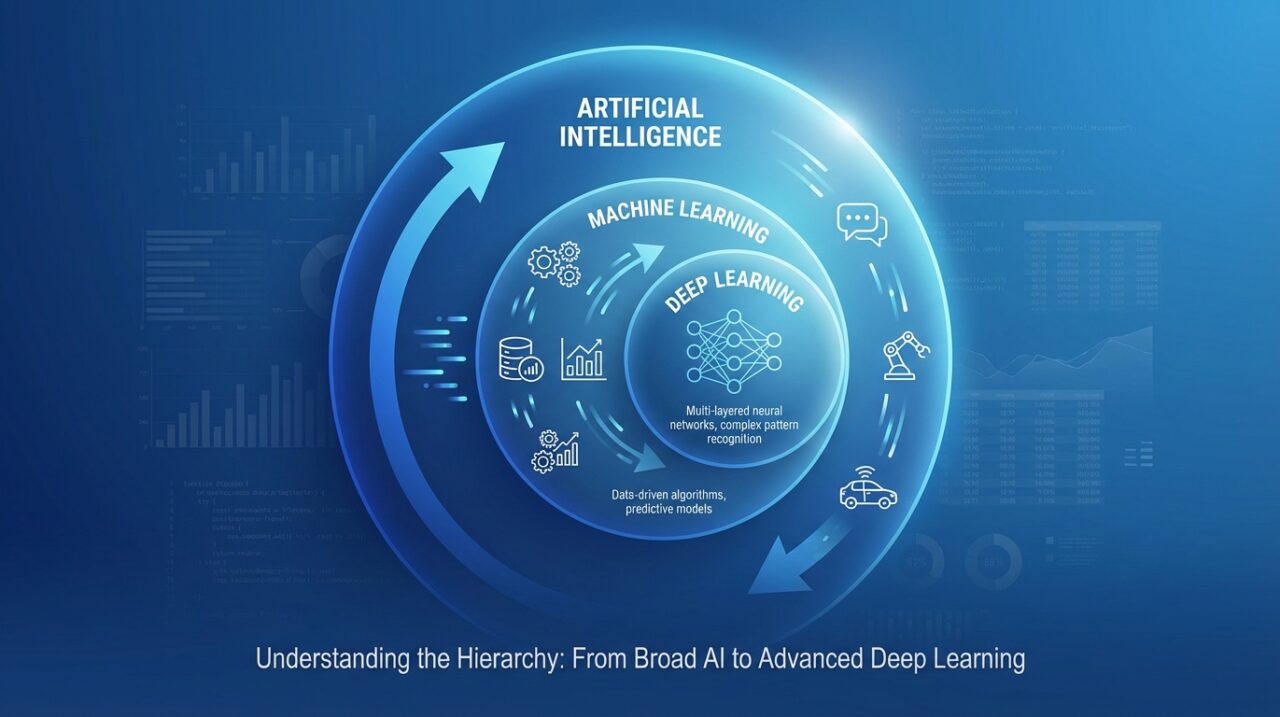
Artificial Intelligence is everywhere. Investors talk about it. Startups pitch it. Enterprises are racing to adopt it.
But here’s the real problem: many founders, CTOs, and product managers still confuse AI, Machine Learning, and Deep Learning. And that confusion often leads to wrong hiring decisions, over-engineered products, inflated budgets, and delayed launches.
If you are planning to build an AI-powered SaaS product, automation platform, analytics engine, or intelligent mobile app, understanding the difference is not optional — it is strategic.
Let’s break it down clearly in business language.
Why This Matters for Startups and Enterprises
AI adoption has accelerated rapidly across industries. Companies using intelligent automation reduce operational costs, improve personalization, and make faster data-driven decisions.
However, not every business needs Deep Learning. Not every product needs complex neural networks. And not every automation tool qualifies as Machine Learning.
Choosing the right approach directly impacts:
- Development cost
- Infrastructure investment
- Time to market
- Scalability
- Long-term maintenance
Understanding the layers helps you build smarter — not heavier.
What Is Artificial Intelligence (AI)?
Artificial Intelligence is the broad concept of machines performing tasks that typically require human intelligence.
AI is the umbrella term.
It includes systems that can:
- Make decisions
- Interpret language
- Recognize patterns
- Automate workflows
- Solve structured problems
Business-Friendly Definition:
AI is the goal of making machines behave intelligently.
Business Examples:
- Chatbots answering customer queries
- Fraud detection systems
- Automated document processing
- Recommendation engines
- Workflow automation systems
AI does not always require Machine Learning. Some AI systems are rule-based and follow predefined logic.
What Is Machine Learning (ML)?
Machine Learning is a subset of AI.
Instead of writing fixed rules, ML systems learn patterns from data and improve over time.
Business-Friendly Definition:
Machine Learning teaches systems to improve automatically from data.
Common Business Applications:
- Customer churn prediction
- Sales forecasting
- Credit risk scoring
- Demand forecasting
- Personalized recommendations
How ML Works in Practice:
- Define the business problem
- Collect relevant data
- Clean and preprocess data
- Train the model
- Evaluate performance
- Deploy via API
- Monitor and retrain
Popular ML Techniques:
- Linear Regression
- Decision Trees
- Random Forest
- Gradient Boosting
- Clustering (K-Means)
ML is ideal when you have structured data and clear prediction goals.
What Is Deep Learning?
Deep Learning is a specialized subset of Machine Learning.
It uses multi-layer neural networks to process complex data such as images, audio, and natural language.
Business-Friendly Definition:
Deep Learning is advanced ML designed for highly complex pattern recognition tasks.
It Powers:
- Image recognition systems
- Speech recognition
- Natural Language Processing
- AI copilots
- Generative AI systems
- Large Language Models
Deep Learning requires:
- Large volumes of data
- High-performance GPUs
- More training time
- Specialized expertise
It is powerful — but not always necessary.
AI vs ML vs Deep Learning — Simple Comparison
| Aspect | AI | ML | Deep Learning |
|---|---|---|---|
| Scope | Broad concept | Subset of AI | Subset of ML |
| Data Requirement | Not always | Required | Large datasets |
| Complexity | Low to High | Medium | High |
| Infrastructure | Basic to Moderate | Moderate | GPU-intensive |
| Typical Use Cases | Automation | Prediction | Vision, NLP, GenAI |
Easy Analogy:
- AI = The vision (intelligent systems)
- ML = The method (learning from data)
- Deep Learning = The advanced engine (neural networks)
Business Benefits of Using the Right Approach
1. Cost Efficiency
Using ML where appropriate avoids unnecessary GPU costs and infrastructure overhead.
2. Better Decision-Making
Predictive analytics improves strategic planning and risk management.
3. Scalable Personalization
Deep Learning enables recommendation engines and AI copilots at scale.
4. Faster Time to Market
Choosing the right model prevents over-engineering.
If you’re evaluating whether your product truly needs AI, ML, or Deep Learning, making the correct architectural decision early can save months of rework and significant capital.
Real-World Use Cases Across Industries
E-Commerce
- Recommendation engines
- Dynamic pricing
- Customer segmentation
FinTech
- Fraud detection systems
- Risk assessment models
- Automated underwriting
Healthcare
- Medical image analysis
- Predictive diagnostics
SaaS Platforms
- Smart dashboards
- AI copilots
- Automated reporting
Logistics
- Route optimization
- Demand forecasting
Every industry uses intelligence differently. The key is selecting the right layer of technology.
Technology Stack for AI-Powered Products
A modern AI system often includes:
Backend
- Python
- FastAPI
- REST APIs
- WebSockets
Machine Learning & AI Frameworks
- TensorFlow
- PyTorch
- Scikit-learn
- OpenAI APIs (for LLM integration)
Frontend
- React.js (web dashboards)
- Flutter (cross-platform mobile apps)
Cloud & Infrastructure
- AWS (EC2, S3, SageMaker)
- Docker
- Kubernetes
- GPU-based deployment environments
A well-designed architecture balances performance, scalability, and cost efficiency.
We offer end-to-end development — from idea validation to AI deployment — ensuring your product is secure, scalable, and future-ready.
Step-by-Step Development Approach
Step 1: Define the Business Objective
Clarify measurable outcomes.
Step 2: Data Strategy
Assess availability, quality, and compliance requirements.
Step 3: Technology Selection
Decide between AI logic, ML models, or Deep Learning.
Step 4: Model Development & Validation
Train, test, and evaluate performance.
Step 5: API Integration
Expose models through scalable backend services.
Step 6: UI/UX Integration
Integrate into web or mobile dashboards.
Step 7: Deployment & Monitoring
Deploy on cloud infrastructure with logging and monitoring.
Step 8: Continuous Optimization
Retrain models and improve performance over time.
If you’re planning to build an AI-driven SaaS or enterprise platform, our team can help design a scalable roadmap tailored to your business goals.
Common Mistakes Businesses Make
- Choosing Deep Learning when ML would work
- Ignoring data quality issues
- Underestimating infrastructure costs
- Treating AI as a one-time feature
- Skipping long-term maintenance planning
AI is not just a feature — it is an evolving ecosystem.
Future Trends Business Leaders Should Watch
AI Agents & Autonomous Systems
Systems that execute tasks independently.
Generative AI in SaaS
Embedded AI copilots inside products.
Edge AI
Processing data closer to the source.
Responsible AI & Compliance
Governance, transparency, and regulation.
AI + Automation Integration
Combining intelligent decision-making with workflow automation.
Enterprises that adopt structured AI strategies today will lead their markets in the next decade.
If you’re exploring how AI can enhance your existing product or planning a new intelligent platform, you can talk to our experts to evaluate feasibility, cost, and scalability.
Conclusion
AI, Machine Learning, and Deep Learning are not competing technologies — they are layered components of intelligent systems.
Understanding the difference allows you to:
- Choose the right architecture
- Control development costs
- Build scalable products
- Deliver measurable ROI
The smartest companies do not chase buzzwords — they implement strategically.
If you’re ready to transform your SaaS platform, mobile app, or enterprise system with AI-driven capabilities, schedule a free consultation and get a tailored strategy roadmap for your business.


 Apr 02, 2026

