





How AI Is Transforming Custom Software Development
 Feb 25,2026
  By Rahul Pandit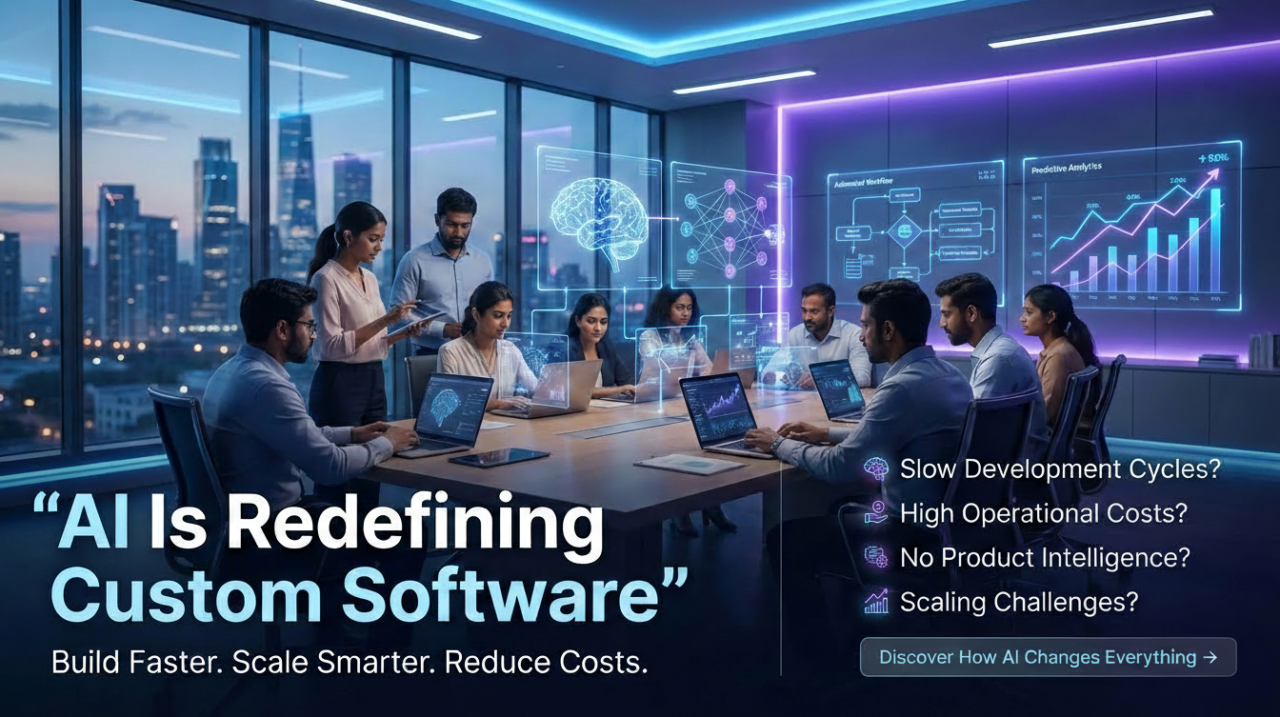
Building custom software used to be a long, linear process — requirement gathering, wireframes, development, testing, deployment. Months of effort. High costs. Uncertain outcomes.
Today, that model is rapidly evolving.
Artificial Intelligence (AI) is transforming how software is designed, built, tested, and scaled. For startup founders, CTOs, and enterprises, AI is no longer an optional enhancement — it’s a strategic advantage.
From automated coding assistance to AI-powered SaaS platforms and predictive analytics engines, AI in custom software development is redefining speed, intelligence, and scalability.
If you’re planning your next digital product, understanding this shift isn’t just helpful — it’s critical.
Industry Insight: AI Adoption Is Accelerating
- 70%+ of enterprises are actively exploring AI integration.
- AI-driven automation reduces development time by up to 30–40%.
- Generative AI tools significantly improve developer productivity.
Startups are using AI to launch lean MVPs faster. Enterprises are embedding AI into existing systems to improve operational efficiency and customer experience.
The competitive gap between AI-enabled businesses and traditional software users is widening — quickly.
What Does AI in Custom Software Development Actually Mean?
AI in software development goes beyond chatbots.
It includes:
- AI-assisted coding and debugging
- Intelligent workflow automation
- Natural Language Processing (NLP)
- Predictive analytics models
- Computer vision systems
- Generative AI and LLM integrations
- Smart personalization engines
Custom software is no longer just functional. It’s becoming adaptive, predictive, and context-aware.
Key Areas Where AI Is Transforming Development
1. Faster Product Development
AI-powered coding assistants help developers:
- Write boilerplate code instantly
- Identify bugs in real-time
- Optimize queries and performance
- Suggest architectural improvements
This reduces manual effort and accelerates MVP delivery.
For startups, this means launching in weeks instead of months.
2. Smarter User Experiences
AI enables:
- Personalized dashboards
- Behavior-based recommendations
- Conversational interfaces
- Voice-enabled applications
- Predictive user flows
For example:
- SaaS platforms that suggest next best actions.
- E-commerce systems that personalize product listings.
- Health apps that provide AI-driven insights.
The result? Higher engagement and retention.
3. Intelligent Automation
AI can automate:
- Invoice processing
- CRM updates
- Data extraction
- Document classification
- Email triaging
Instead of building static systems, businesses are creating intelligent automation layers that learn over time.
4. Predictive Analytics & Decision Support
Custom AI applications can:
- Forecast sales trends
- Predict churn
- Identify fraud patterns
- Optimize supply chains
- Improve marketing ROI
For CTOs and product managers, this means moving from reactive systems to proactive intelligence.
Real-World Use Cases Across Industries
FinTech
- Fraud detection models
- Automated underwriting systems
- Risk scoring engines
Healthcare
- Remote patient monitoring dashboards
- AI diagnostic assistants
- Predictive health analytics
Logistics
- Route optimization engines
- Demand forecasting systems
- Smart inventory allocation
EdTech
- Adaptive learning platforms
- AI tutors
- Personalized content delivery
SaaS Platforms
- Embedded AI copilots
- Automated reporting
- Intelligent search functionality
If you’re planning to build something similar, our team can help you design AI-first architectures that scale securely and efficiently.
Technology Stack for AI-Driven Custom Software
AI-based solutions require a thoughtful tech stack.
Frontend:
- React.js
- Next.js
- Flutter (for cross-platform mobile apps)
Backend:
- Python
- FastAPI
- Node.js
- Microservices architecture
AI/ML Layer:
- LLM APIs
- Custom ML models
- NLP frameworks
- Vector databases for semantic search
Cloud Infrastructure:
- AWS
- Azure
- Google Cloud
- Serverless architecture
- Kubernetes
DevOps & CI/CD:
- Docker
- GitHub Actions
- Infrastructure as Code
The key is building modular architecture that allows AI components to evolve independently without disrupting the core system.
We offer end-to-end development from idea validation to AI model deployment and scaling.
Step-by-Step Approach to Building AI-Powered Custom Software
Step 1: Problem Definition
Identify the core business problem. AI should solve something measurable — not just be added for hype.
Step 2: Data Strategy
AI systems depend on data quality. Define:
- Data sources
- Data cleaning processes
- Storage architecture
Step 3: MVP with AI Core
Build a lean product with:
- Core features
- Limited AI functionality
- Clear validation metrics
Step 4: Model Integration
Integrate:
- Pre-trained LLMs
- Custom-trained ML models
- Automation pipelines
Step 5: Testing & Optimization
- A/B testing AI outputs
- Performance tuning
- Security audits
Step 6: Scale with Monitoring
Use:
- Analytics dashboards
- Model monitoring tools
- Continuous learning pipelines
This structured approach ensures AI enhances value rather than increasing complexity.
Common Mistakes Businesses Make
❌ Adding AI Without a Clear Use Case
AI should solve a defined business problem.
❌ Ignoring Data Readiness
Poor data leads to unreliable outputs.
❌ Overbuilding in Early Stages
Start lean. Validate fast.
❌ Neglecting Security & Compliance
AI systems must protect user data and comply with regulations.
❌ Underestimating Infrastructure Costs
AI workloads can increase compute requirements.
Avoiding these pitfalls can save months of rework and significant budget overruns.
Benefits of AI in Custom Software Development
1. Reduced Development Time
Automation and AI-assisted coding speed up cycles.
2. Lower Operational Costs
Intelligent automation reduces manual tasks.
3. Competitive Advantage
AI-driven insights outperform traditional systems.
4. Better Customer Experience
Personalized and predictive systems increase satisfaction.
5. Scalable SaaS Architecture
AI enhances product stickiness and long-term retention.
If you’re evaluating AI for your product roadmap, you can Schedule a Free Consultation to explore feasibility and ROI analysis.
The Future of AI in Software Development
AI is moving toward:
- Autonomous agents performing multi-step tasks
- Self-healing applications
- Real-time personalization engines
- AI-native SaaS platforms
- Edge AI for mobile apps
- Multi-modal AI (text, image, video, voice)
In the next 3–5 years, AI won’t just support software — it will co-create it.
Businesses that integrate AI early will dominate their markets.
Conclusion
AI is not replacing custom software development — it is elevating it.
From faster coding cycles to predictive intelligence, AI empowers startups and enterprises to build smarter, scalable, and future-ready digital products.
The question is no longer whether to adopt AI — it’s how strategically you implement it.
If you’re planning to build an AI-powered platform, SaaS product, or intelligent enterprise solution, Talk to Our Experts and get a tailored roadmap for your business goals.
The future of software is intelligent. Make sure yours is too.
Frequently Asked Questions (FAQs)
1. How is AI used in custom software development?
AI is used in custom software development for automated coding assistance, predictive analytics, intelligent workflow automation, chatbot integration, personalization engines, fraud detection, and advanced data analysis. It helps businesses build smarter, faster, and more scalable digital products.
2. Is AI integration expensive for startups?
AI integration costs depend on the scope, infrastructure, and data complexity. Startups can begin with lightweight AI features using third-party APIs or pre-trained models and gradually scale into custom AI models as their user base and revenue grow.
3. Which industries benefit most from AI-powered custom software?
Industries such as FinTech, healthcare, logistics, SaaS, e-commerce, and EdTech benefit significantly from AI-powered custom software due to automation, predictive decision-making, personalization, and operational efficiency improvements.
4. What is the best tech stack for AI-based software development?
A common AI software stack includes React or Flutter for frontend, Python with FastAPI or Node.js for backend, cloud platforms like AWS or Azure for infrastructure, and LLM APIs or custom machine learning models for AI capabilities.
5. How long does it take to develop AI-powered custom software?
An AI-enabled MVP can typically take 8–12 weeks depending on complexity and data readiness. Enterprise-grade AI systems with custom model training, integration, and compliance requirements may take several months to fully deploy and optimize.


 Apr 02, 2026

