









Top 10 Real-World Applications of AI in 2026
 Apr 02,2026
  By Rahul Pandit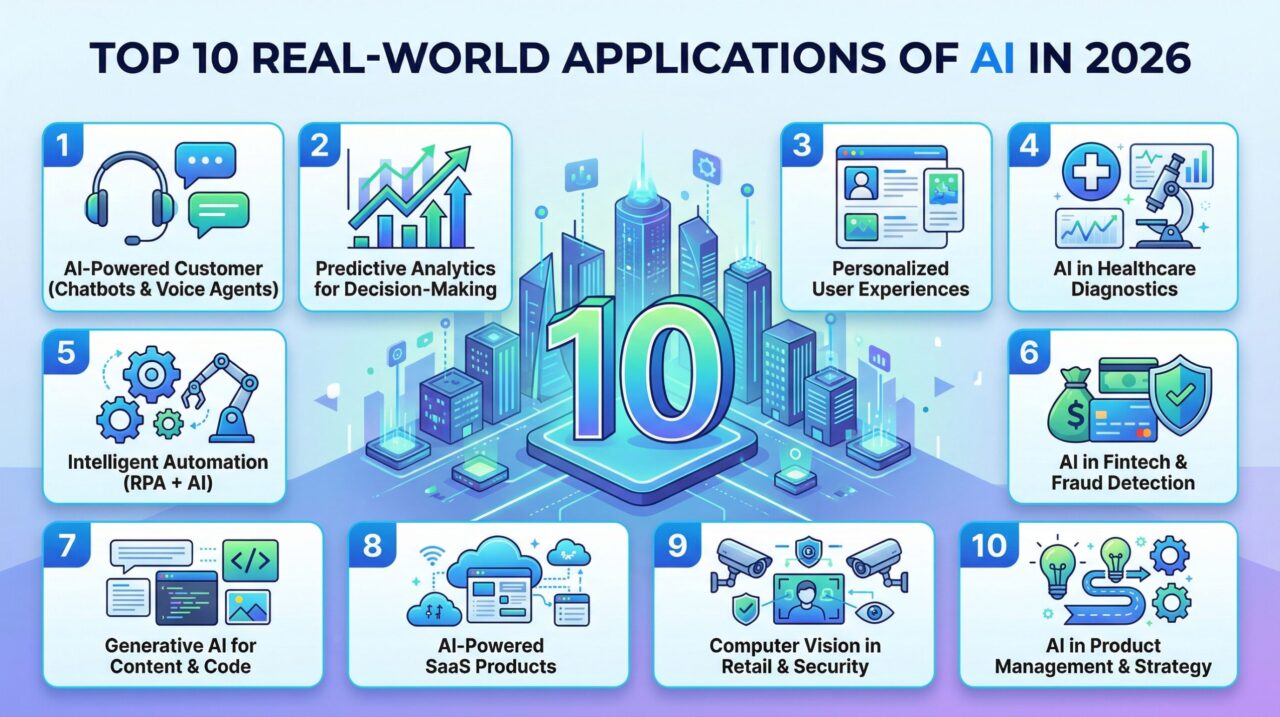
AI has moved from experimental labs to core business operations. In 2026, companies that fail to adopt AI are not just behind—they’re losing revenue, efficiency, and competitive advantage.
From automated customer support to predictive decision-making, AI is now embedded into products, platforms, and processes. The real question is no longer “Should we use AI?” but “Where can AI create the most impact in our business?”
Industry Insight: The AI Acceleration
| Insight | Details |
|---|---|
| Adoption Rate | Over 80% of enterprises now use AI in at least one business function |
| Cost Reduction | AI-driven automation reduces operational costs by up to 40% |
| Economic Impact | Generative AI alone is expected to contribute trillions to global GDP |
This shift is driven by accessible tools like LLM APIs, cloud AI platforms, and scalable SaaS architectures.
Top 10 Real-World AI Applications in 2026
1. AI-Powered Customer Support (Chatbots & Voice Agents)
Modern AI chatbots go far beyond scripted responses. They understand context, intent, and even sentiment.
Use Case:
- SaaS platforms resolving 70–80% of support queries automatically
Tech Stack Example:
- OpenAI / Claude APIs
- Node.js / FastAPI backend
- React chat interfaces
- AWS Lambda for scaling
Business Impact:
- Reduced support costs
- 24/7 availability
- Improved customer satisfaction
2. Predictive Analytics for Decision-Making
AI models analyze historical and real-time data to predict trends.
Use Case:
- Sales forecasting, churn prediction, inventory optimization
Example:
An eCommerce company uses AI to predict which products will sell next month and adjusts inventory accordingly.
3. Personalized User Experiences
AI enables hyper-personalization across apps and platforms.
Use Case:
- Netflix-style recommendations
- Personalized dashboards in SaaS tools
Tech Stack:
- Python ML models
- Recommendation engines
- User behavior tracking systems
4. AI in Healthcare Diagnostics
AI assists doctors in detecting diseases faster and more accurately.
Applications:
- Medical imaging analysis
- Early disease detection
- Patient risk scoring
5. Intelligent Automation (RPA + AI)
Combining Robotic Process Automation (RPA) with AI creates self-learning workflows.
Use Case:
- Invoice processing
- HR onboarding automation
- Compliance checks
6. AI in Fintech & Fraud Detection
AI monitors transactions in real-time to detect anomalies.
Use Case:
- Fraud detection systems in payment gateways
- Credit risk analysis
Example:
AI flags suspicious transactions instantly, reducing fraud losses significantly.
7. Generative AI for Content & Code
Generative AI is transforming how businesses create content and software.
Applications:
- Blog writing, marketing copy
- Code generation and debugging
- UI/UX mockups
Tools:
- GPT-based systems
- GitHub Copilot
- Design AI tools
8. AI-Powered SaaS Products
AI is now a core feature in modern SaaS platforms.
Examples:
- CRM systems with AI insights
- AI-based analytics dashboards
- Smart workflow automation tools
9. Computer Vision in Retail & Security
AI-powered vision systems analyze images and video streams.
Use Case:
- Retail checkout automation
- Facial recognition security
- Inventory tracking
10. AI in Product Management & Strategy
AI helps product teams make better decisions faster.
Use Case:
- Feature prioritization
- User feedback analysis
- Market trend insights
Product managers now rely on AI dashboards to guide roadmap decisions.
If you’re planning to build an AI-powered SaaS product, our team can help you design scalable, production-ready solutions tailored to your business model.
Benefits of AI for Businesses
- Faster and smarter decision-making
- Reduced operational costs
- Improved customer experiences
- Scalable growth without proportional cost increase
- Stronger competitive positioning
Step-by-Step Approach to Building AI Solutions
1. Define the Problem
Focus on high-impact use cases aligned with business goals.
2. Prepare Data
Clean, structured, and relevant data is essential for effective AI models.
3. Select the Right Technology
Choose appropriate models such as LLMs, predictive analytics, or computer vision.
4. Build Infrastructure
Use scalable backend frameworks like FastAPI or Node.js with cloud platforms like AWS.
5. Develop User Interfaces
Create intuitive dashboards using React or Flutter.
6. Test Thoroughly
Ensure performance, accuracy, and reliability through QA processes.
7. Deploy and Optimize
Monitor continuously and improve based on real-world usage.
We offer end-to-end AI development—from ideation to deployment—ensuring your solution is scalable, secure, and business-ready.
Common Mistakes to Avoid
- Lack of clear business objectives
- Poor data quality
- Overcomplicating initial solutions
- Ignoring scalability requirements
- Insufficient testing and validation
Future Trends in AI (2026 and Beyond)
- Agentic AI systems performing multi-step tasks autonomously
- AI-native SaaS platforms becoming the norm
- Real-time AI decision engines
- Increased focus on AI governance and ethics
- Integration of AI with IoT and edge computing
Businesses that invest early in these trends will lead their industries.
Conclusion
AI in 2026 is not just a technology upgrade—it’s a business transformation engine. From customer support to product strategy, AI is redefining how companies operate, compete, and grow.
The key is not just adopting AI, but implementing it strategically with the right architecture, tools, and expertise.
If you’re exploring how AI can fit into your product or business, this is the right time to act. You can Schedule a Free Consultation or Talk to Our Experts to evaluate opportunities tailored to your goals.
FAQs
1. What are the most important AI applications in 2026?
Key AI applications include customer support automation, predictive analytics, generative AI, fraud detection, and personalized user experiences across digital platforms.
2. How can AI improve business efficiency?
AI automates repetitive tasks, provides real-time insights, and reduces manual errors, leading to faster operations and lower costs.
3. What technologies are commonly used in AI development?
Technologies include Python, FastAPI, React, Flutter, AWS, machine learning frameworks, and LLM APIs like GPT.
4. Is AI affordable for startups?
Yes, cloud-based AI tools and APIs make it cost-effective for startups to build and scale AI solutions without heavy upfront investment.
5. How long does it take to develop an AI solution?
Development timelines vary from a few weeks for basic solutions to several months for complex, enterprise-grade AI systems.


 Apr 02, 2026

