







AI Agents vs Traditional Chatbots: What Every Business Leader Needs to Know in 2025
 Apr 02,2026
  By Rahul Pandit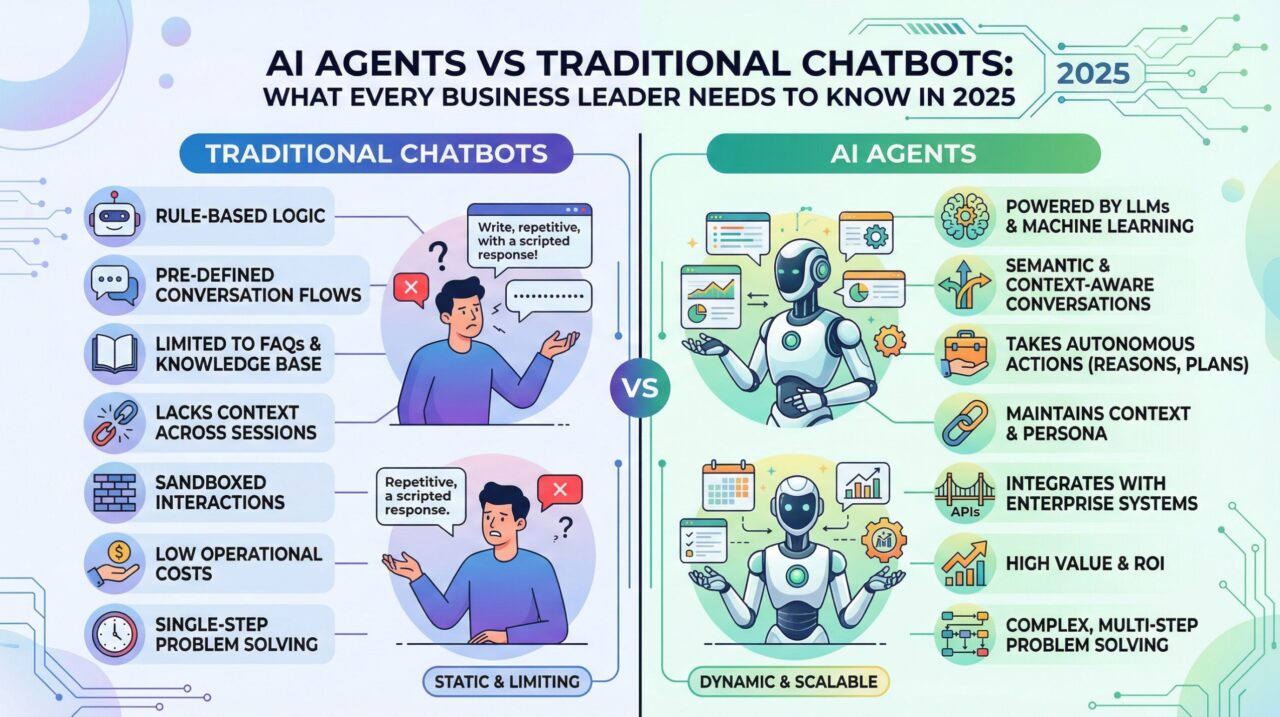
Your customers are texting your support bot at 2 a.m., and it’s replying with ‘I’m sorry, I didn’t understand that.’ Meanwhile, your competitor’s AI agent just autonomously resolved a complex refund request, scheduled a follow-up, updated the CRM, and sent a personalised email — all without a single human in the loop.
This is no longer a futuristic scenario. It’s happening right now across industries, and businesses that fail to understand the difference between AI agents and traditional chatbots are leaving serious money — and customer loyalty — on the table.
In this article, we break down exactly what separates these two technologies, which one is right for your business stage, and how forward-thinking companies are building AI-first systems that scale.
The Numbers Don’t Lie: AI Is Reshaping Customer Interaction
The intelligent chatbot market was valued at over $7.7 billion in 2024 and is projected to surpass $27 billion by 2030. Yet despite this explosive growth, a majority of users still report frustration with rule-based bots — citing repetitive loops, inability to handle exceptions, and zero contextual memory.
AI agents, on the other hand, are witnessing adoption surges in enterprise tech, SaaS platforms, fintech, and e-commerce — precisely because they move beyond scripted responses into real decision-making territory.
Understanding this shift isn’t just a technology exercise — it’s a business strategy imperative.
What Is a Traditional Chatbot?
Traditional chatbots operate on rule-based logic trees or basic Natural Language Processing (NLP) models. They are designed to handle a predefined set of intents — essentially answering questions that developers have already anticipated.
Key Characteristics
- Decision trees & scripted flows
- Limited NLP — keyword matching or intent classification
- No memory between sessions
- Cannot take actions outside the conversation window
- Requires constant manual updates to expand capabilities
Traditional chatbots are excellent for simple, high-volume FAQ deflection — things like “What are your business hours?” or “How do I reset my password?” But push them beyond their training scope, and they fall apart immediately.
What Is an AI Agent?
An AI agent is a fundamentally different beast. It combines the reasoning capabilities of large language models (LLMs) with the ability to use tools, access external data, make decisions, and execute multi-step workflows — all autonomously.
Key Characteristics
- Powered by LLMs (GPT-4, Claude, Gemini, LLaMA, etc.)
- Can browse the web, call APIs, write and run code
- Maintains memory across sessions and context windows
- Uses planning frameworks (ReAct, Chain-of-Thought, AutoGPT-style loops)
- Adapts its response strategy based on goals, not scripts
- Can orchestrate other sub-agents (multi-agent architecture)
Think of a traditional chatbot as a scripted call center repreading from a manual. An AI agent is the experienced manager who reads the situation, checks the system, calls in the right team, and resolves the issue — end to end.
AI Agents vs Traditional Chatbots: A Direct Comparison
| Feature | Traditional Chatbot | AI Agent |
| Intelligence | Rule-based / scripted NLP | LLM-powered reasoning |
| Memory | Session-only or none | Persistent, contextual memory |
| Actions | Text responses only | API calls, data writes, code execution |
| Adaptability | Manual updates required | Self-improves via prompting & RAG |
| Complexity Handling | Simple, linear queries | Multi-step, ambiguous tasks |
| Integration Depth | Limited (webhooks only) | Deep (CRM, ERP, databases, APIs) |
| Cost to Deploy | Low initial cost | Higher initial, lower long-term cost |
| Scalability | Limited by script scope | Virtually unlimited task scope |
Not sure which solution fits your product roadmap? Our team helps startups and enterprises evaluate, design, and build the right AI architecture — from day one. → Schedule a Free Consultation
Business Benefits of Upgrading to AI Agents
1. Dramatically Higher Automation Rates
Traditional chatbots typically automate 30–40% of tier-1 support tickets. AI agents can resolve 70–85% of complex queries autonomously, reducing support costs and improving first-contact resolution significantly.
2. Revenue-Generating Interactions
AI agents don’t just deflect — they sell. They can proactively recommend upsells based on user behaviour, process orders, initiate trial activations, and follow up on abandoned carts — all within a single conversation thread.
3. 24/7 Operations Without Human Fatigue
Unlike human agents or rule-based bots that degrade in quality over time, AI agents maintain consistent performance across millions of simultaneous interactions — at any hour, in any timezone.
4. Deep CRM & ERP Integration
AI agents natively integrate with Salesforce, HubSpot, Zendesk, Jira, and custom databases. They read, write, and update records in real time — eliminating manual data entry and ensuring clean, live data across your systems.
5. Compound Learning Over Time
With Retrieval-Augmented Generation (RAG) and fine-tuning capabilities, AI agents get smarter the more they’re used. Your knowledge base, past tickets, and product documentation all become live inputs that continuously improve agent performance.
Real-World Use Cases by Industry
E-Commerce & Retail
- AI agent handles order tracking, returns, and exchanges end-to-end
- Personalises product discovery based on purchase history
- Sends proactive restock alerts and loyalty nudges
FinTech & Banking
- Processes loan pre-qualification in minutes
- Detects and flags anomalous transactions in real time
- Answers complex policy questions with document retrieval (RAG)
SaaS & B2B Platforms
- Onboards new users step-by-step inside the product
- Identifies churn signals and triggers retention workflows
- Schedules demos and qualifies leads directly in chat
Healthcare & Wellness
- Pre-screens patient symptoms and routes to the right specialist
- Automates appointment scheduling and reminders
- Provides evidence-based responses from vetted medical knowledge bases
Technology Stack for Building AI Agents
For teams looking to build production-grade AI agents, here is the modern stack that leading engineering teams are using:
LLM & AI Layer
- OpenAI GPT-4 / GPT-4o
- Anthropic Claude 3.5 / 3 Opus
- Google Gemini Pro / Flash
- Meta LLaMA 3 (open-source, self-hosted)
Agent Frameworks
- LangChain / LangGraph — orchestration, memory, tool use
- CrewAI — multi-agent role-based collaboration
- AutoGen (Microsoft) — conversational multi-agent systems
Backend & APIs
- FastAPI (Python) — high-performance async API layer
- Node.js + Express — real-time event handling
- PostgreSQL + pgvector — vector embeddings for RAG
- Redis — session memory and caching
Frontend & Interfaces
- React.js — web-based chat interfaces
- Flutter — cross-platform mobile AI assistants
- Streamlit / Gradio — rapid prototyping dashboards
Infrastructure & Deployment
- AWS (Lambda, ECS, Bedrock) — scalable serverless deployment
- GCP Vertex AI — managed LLM endpoints
- Docker + Kubernetes — containerised agent orchestration
- Pinecone / Weaviate / Qdrant — vector databases for memory
🚀 Building an AI agent requires more than just picking an LLM. Our engineers have hands-on experience across the full stack — from RAG pipelines to multi-agent systems. → Talk to Our Experts
Step-by-Step: How to Build an AI Agent for Your Business
- Define the Agent’s Goal — What specific workflow or problem should the agent own? Be precise.
- Map the Data Sources — Identify what knowledge bases, CRMs, and APIs the agent needs access to.
- Select the Right LLM — Match model capabilities (context length, speed, cost) to your use case.
- Design the Tool Set — Define which external tools the agent can call (APIs, DB queries, email triggers).
- Build the Memory Layer — Implement short-term (session) and long-term (vector DB) memory.
- Implement RAG Pipeline — Connect your documents, FAQs, and knowledge base for accurate retrieval.
- Test with Edge Cases — Run adversarial tests: hallucinations, jailbreaks, ambiguous inputs.
- Deploy with Guardrails — Use output filtering, rate limiting, and human-in-the-loop escalation.
- Monitor & Iterate — Track resolution rate, escalation rate, CSAT, and LLM cost per interaction.
Common Mistakes to Avoid
- Over-automating too early — Start with a narrow, well-defined use case before expanding scope.
- Ignoring guardrails — Unguarded LLMs can hallucinate dangerously in regulated industries. Always implement output validation.
- Using the wrong model — GPT-4o is powerful but expensive. For high-volume tasks, consider fine-tuned smaller models or Claude Haiku.
- Skipping memory architecture — An agent without memory feels broken after every session. Design for continuity from day one.
- No fallback to human agents — Always build escalation paths. AI agents must know their limits.
- Treating chatbots and agents as the same thing — Deploying a chatbot when you need an agent (or vice versa) wastes budget and frustrates users.
Future Trends: Where AI Agents Are Heading
Multi-Agent Orchestration
The future isn’t one agent — it’s entire AI teams. Orchestrator agents will manage specialist sub-agents (data retrieval, communication, analysis) in real time, handling workflows that previously required entire human departments.
Voice-Native AI Agents
Text-based agents are just the beginning. Real-time voice agents powered by Whisper, ElevenLabs, and WebRTC are already handling phone-based customer interactions with near-human latency and naturalness.
Agentic SaaS Platforms
The next generation of SaaS won’t just give users a dashboard — it will give them an AI agent that autonomously manages the software on their behalf. Think: an AI that runs your CRM, not just lives in it.
On-Device AI Agents
With Apple Intelligence, Gemini Nano, and local LLM runtimes, AI agents will increasingly run directly on mobile and edge devices — enabling offline functionality and radical privacy compliance.
Regulatory Frameworks
As AI agents gain the ability to sign documents, execute financial transactions, and make health decisions, expect new compliance frameworks (EU AI Act, NIST AI RMF) to define accountability standards for autonomous systems.
Conclusion: Choose the Right Tool for the Right Problem
Traditional chatbots are not obsolete — they remain a practical, cost-effective solution for high-volume, low-complexity interactions. But if your ambition is to build intelligent, scalable, customer-delighting product experiences, AI agents are no longer optional — they are essential.
The businesses winning in 2025 and beyond are those that understand this distinction clearly, invest in the right architecture early, and partner with development teams who have built production AI systems — not just prototypes.
Whether you’re exploring AI for the first time or scaling an existing agent to production, we offer end-to-end development from architecture design to deployment and monitoring. → Get a Project Estimation
FAQ Section
Q1: What is the main difference between AI agents and traditional chatbots?
Traditional chatbots follow fixed scripts and rule-based decision trees, responding only to pre-programmed inputs. AI agents use large language models (LLMs) to reason, plan, use external tools, and autonomously execute multi-step tasks — making them far more capable for complex business workflows.
Q2: Are AI agents more expensive to build than traditional chatbots?
The upfront development cost for AI agents is higher due to LLM API usage, memory architecture, and integration complexity. However, the long-term ROI is significantly better — AI agents handle higher ticket volumes, reduce human support headcount needs, and drive revenue through intelligent automation.
Q3: Can traditional chatbots be upgraded to AI agents?
Yes, but it typically requires a re-architecture rather than a simple upgrade. The conversation logic, data integrations, and backend infrastructure need to be rebuilt to support LLM reasoning and tool use. Attempting to bolt an LLM onto an existing scripted chatbot often produces poor results.
Q4: Which industries benefit most from AI agents in 2025?
E-commerce, FinTech, SaaS, healthcare, and legal services are seeing the strongest ROI from AI agent deployment. Any industry with high customer interaction volume, complex query resolution needs, or significant manual back-office operations is a strong candidate.
Q5: How long does it take to build and deploy an AI agent?
A focused, well-scoped AI agent for a single use case (e.g., customer support tier-1 automation) can be built and deployed in 6–12 weeks by an experienced team. Enterprise-grade multi-agent systems with deep CRM/ERP integration typically require 3–6 months for full production deployment.


 Apr 02, 2026

